
🎓💼📉 Young, Educated, & Unemployed
Unemployment rates for young graduates keep rising... is it AI or somethings else?

“Is college worth it?” used to be a semi-fringe question in public and economic policy. Today, it’s squarely mainstream. In a recent poll, only 33% of responders said college was worth the cost, down from 53% in 2013. Reducing this complicated issue into a simple yes/no is an oversimplification, but these polls and conversations do reflect major shifts in the way we think about investing in college. College costs are absurd, and people are right to question the return-on-investment.
That said, I’m not here to resolve the broader “worth it” debate. What I do find interesting are the underlying labor market trends for young college graduates:
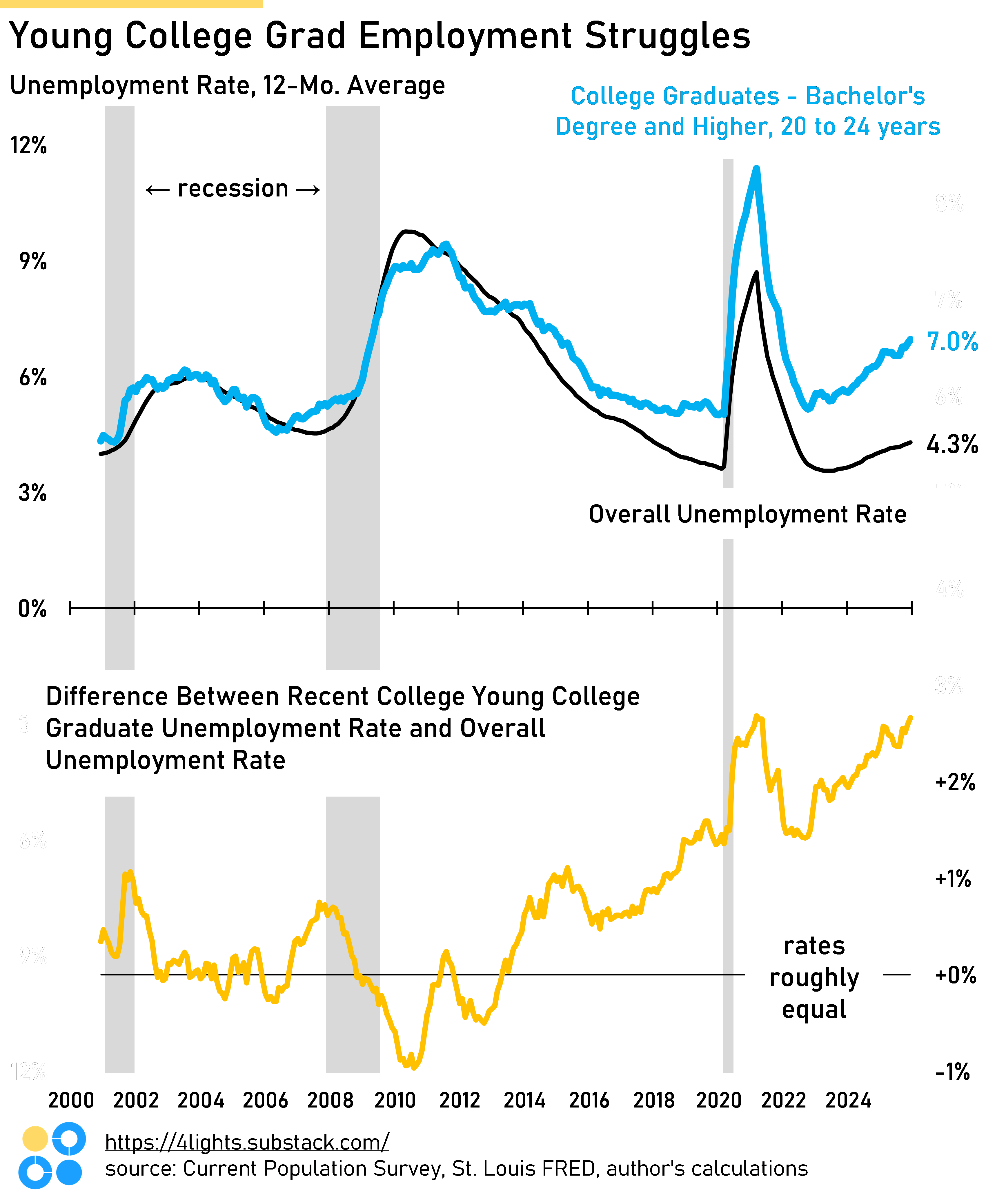
For most of the period where data is available, young college graduates (ages 20-24) experienced unemployment rates within about ±1% of the overall unemployment rate. In other words, a newly minted graduate faced roughly the same risk of unemployment as the broader workforce. Starting around 2008, young graduates actually did better and enjoyed lower unemployment rates than the overall labor market through much of the post–Great Recession recovery.
That pattern began to reverse around 2014. Since then, unemployment among young college graduates never fell below 5%1, while the gap between their unemployment rate and the overall rate has steadily widened. Today, young college graduates face an unemployment rate of roughly 7%, notably higher than the broader workforce.
Is it AI?
Some observers are quick to attribute this trend to AI, but that explanation seems premature. ChatGPT was released in early 2023, yet the trend looks largely unchanged before and after. Long before the AI boom, hiring managers and human resources groups noted that young graduates aren’t prepared for work. Anecdotally, a friend of mine who works in a successful consulting firm recently lamented that all of the young men he hired over the last few years (all from prestigious universities) were “total disasters”. Factor in excessive grade inflation and it’s not surprising that hiring managers are less inclined to take a risk on a young new graduate.2
It’s also worth keeping the scale in mind. Depending on how you count, roughly 250,000 people ages 20–24 with a college degree or higher are currently unemployed. That’s only about 3% of the total unemployed population. The issue isn’t size—it’s what this growing gap may be signaling about how education, hiring, and early-career work are evolving.
12-mo. moving average of not-seasonally adjusted rates.
Which is a shame, particularly in government work. I have always felt that government should be hiring more young people. Its workforce is relatively old, and not representative of the rest of the workforce. There are about 165k government workers under age 30 versus 316k workers ages 60 and older.