

The labor market and jobs situation has been a mixed bag lately. On the positive side, job growth somewhat resumed in the last few months: job growth averaged just +8k jobs per month for all of 2025, but has averaged a respectable +137k per month since March. On the other hand, the labor force — the number of people within an economy who are either working or actively seeking work — is on a downward trend, as of late.
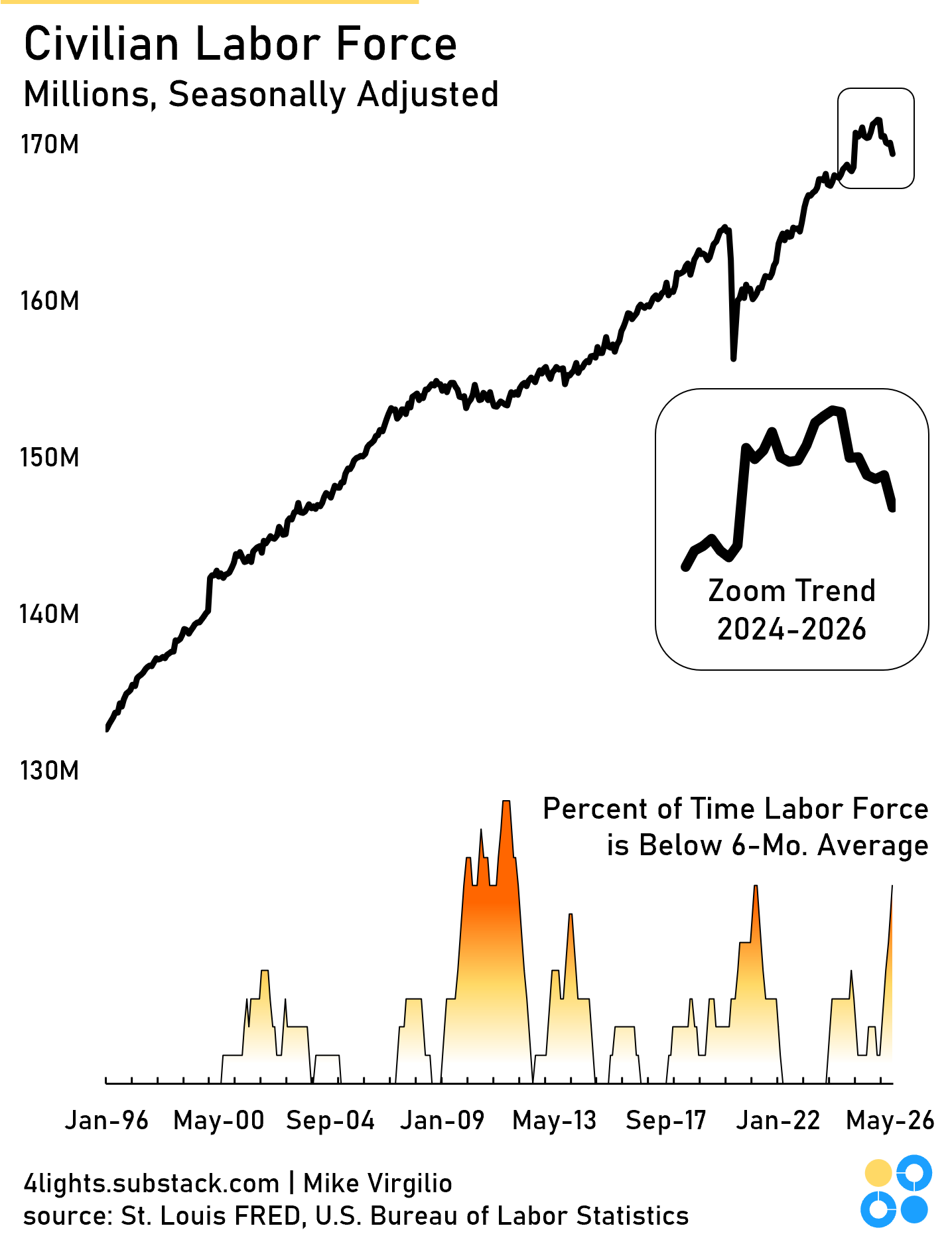
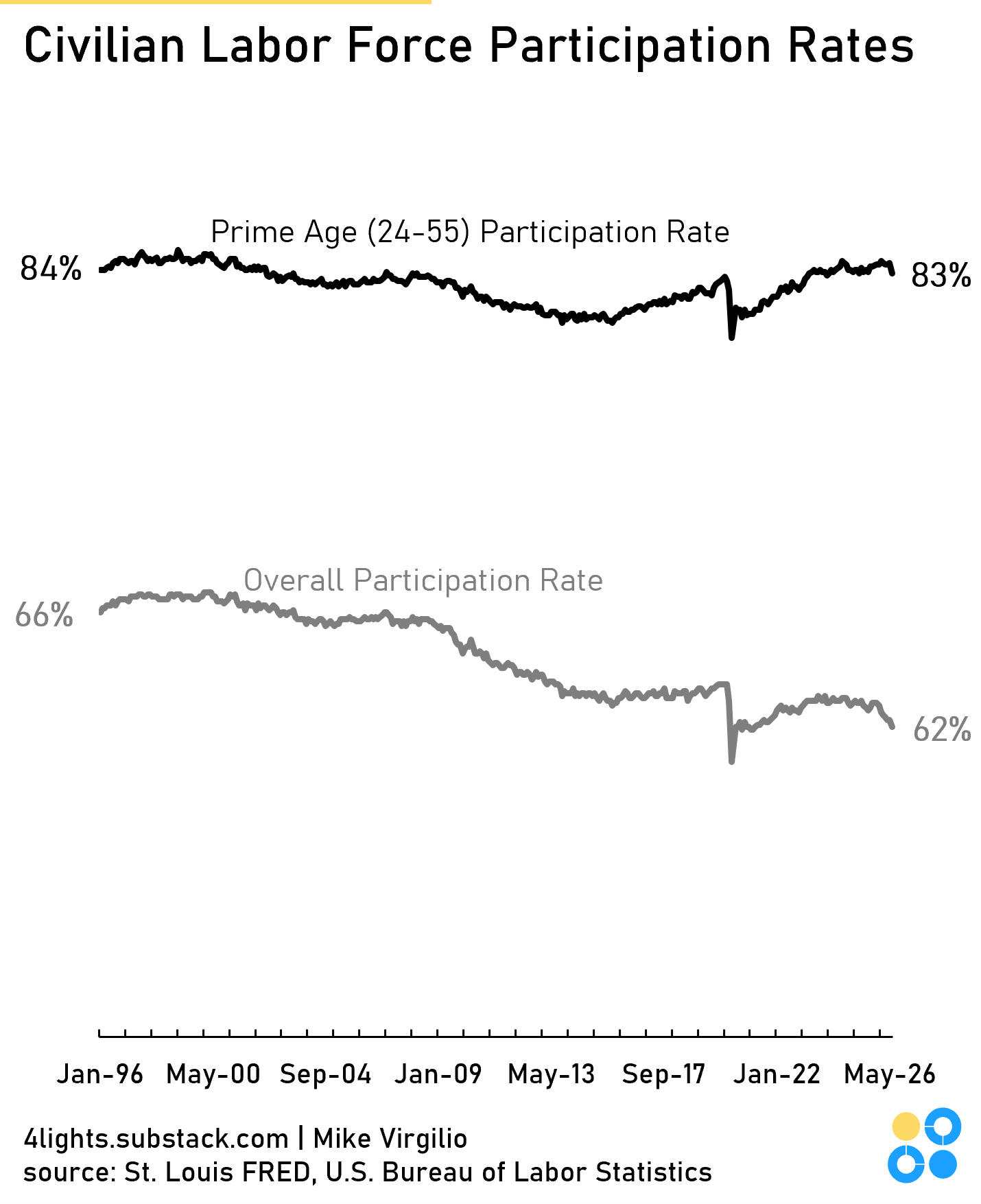
That blip at the end of the graph represents about 2.1 million people who are no longer in the workforce. This is also reflected in the labor force participation rate — the percentage of a population who are in the labor force — which fell to 61.5% in June 2026, the lowest outside the COVID period in 50 years. That said, the so-called “prime age” (ages 24-55) participation rate has mostly held steady at around 83%.
Why is this happening?
Boomers retiring: 11,000 Boomers turn 65 every day, and many of them are leaving the workforce. The strong stock market is probably encouraging a lot of younger Boomers to retire early, as well.
Immigration restriction: It’s unclear how many foreign-born people have been denied entry, detained, or removed in the last few years — the government statistics are not up-to-date — so I don’t want to speculate. What we do know is that foreign-born workers have a higher participation rate (65.6%) than native-born workers (61.0%), so their exit hits total labor supply disproportionately.
Fewer young entrants: Younger people (ages 16-24) are struggling in this “low-hire/low-fire” job market. Normally, this group would be rushing into the labor market to fill new vacancies, but their labor force participation rate is falling faster than ever.
So why is this bad?
The main problem manifests in the U.S. federal budget. We spend a lot of money on elderly retirement benefits (Social Security, Medicare, and sometimes Medicaid), and those benefits are funded by payroll taxes. When people leave the labor force, the government loses revenue to cover those benefits. A crude estimate says that reducing the workforce by 2.1M people will lower tax revenue by $25-$35 billion. Boomers transitioning from the working world into the retirement benefit world is a double-hit to the budget because the government simultaneously stops collecting revenue from their paychecks and starts paying benefits. Many immigrants pay taxes without receiving any benefits, so losing them also deals a significant blow to our long-term fiscal trajectory.