

The jobs market has quietly weakened over the last couple of years. On a year-over-year basis, total employment growth was just +0.3% in May and has been uncomfortably close to turning negative for months. Beneath that weak headline number are several unusual sub-trends including a growing divide between business sizes. Small1 businesses (<20 employees) and large businesses (>250 employees) are still adding workers at a healthy pace, but employment growth among mid-sized firms (20 to 249 employees) has completely stalled:
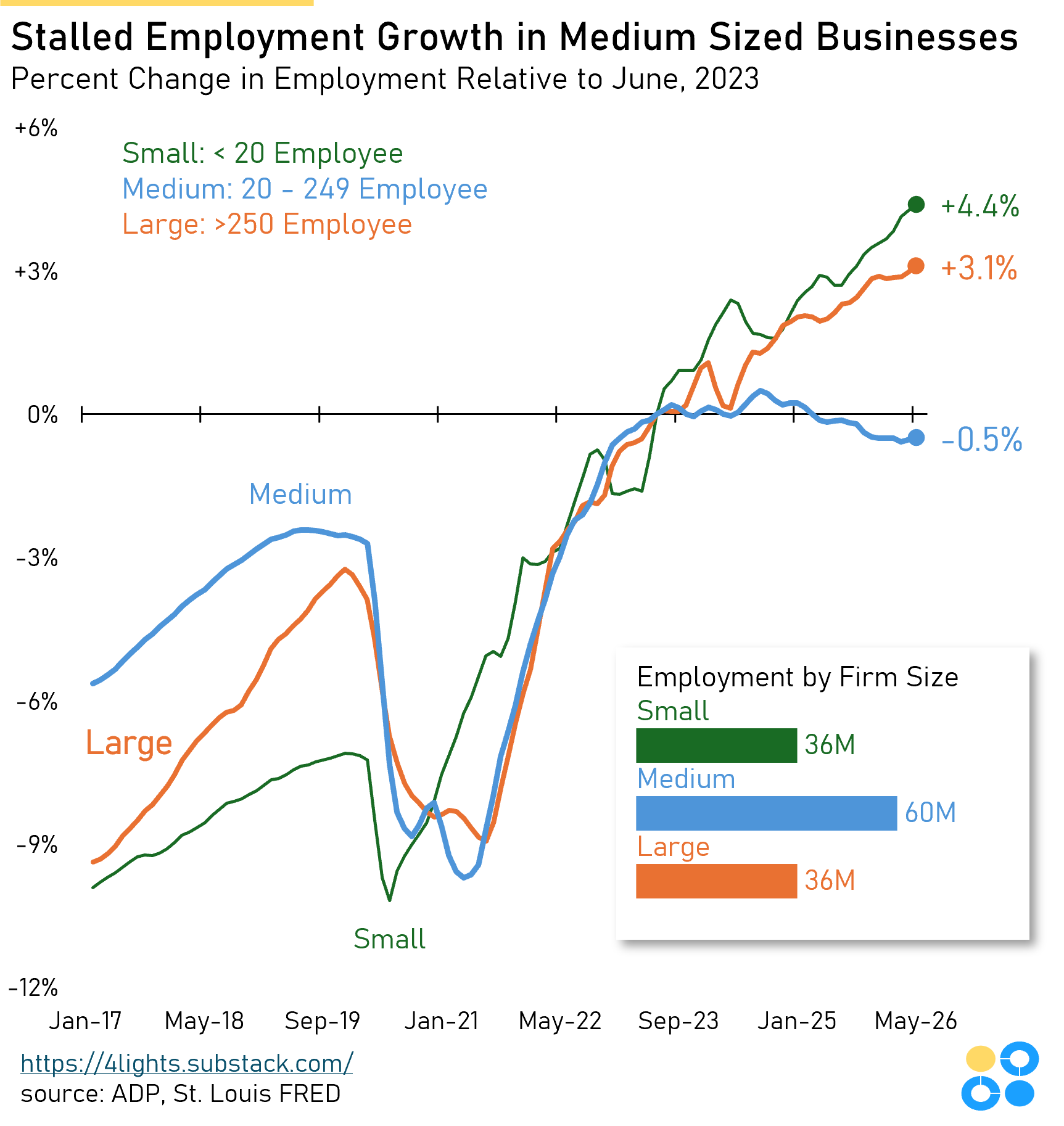
At first glance, most people would probably assume this is just another story about large corporations dominating the economy, but that’s not quite what the data shows. Instead, the labor market increasingly resembles an hourglass economy: strength at the very small end and the very large end, while the middle struggles to grow.
So what’s going on? Here are some basic theories:
Large firms are pulling away from the middle: Big companies have major advantages in recruiting, technology, financing, and compliance. They can offer better pay, benefits, remote work, and job security, making it increasingly difficult for mid-sized employers to compete for both workers and market share.
Higher interest rates hit mid-sized firms hardest: Large corporations still have access to bond markets while small businesses can often survive through flexibility and owner labor. Mid-sized firms depend heavily on regional banks and commercial lending, leaving them especially exposed to tighter credit conditions after 2023.
AI and automation are squeezing the middle market: Large firms can afford enterprise automation while very small businesses often operate in hands-on local services that are difficult to automate. Mid-sized firms are heavily concentrated in administrative, operational, and repeatable knowledge-work roles that AI tools are beginning to replace first.
The pandemic accelerated consolidation trends: COVID strengthened e-commerce, centralized logistics, and software adoption, allowing large firms to gain even more scale advantages. Many small businesses adapted through contracting and local services, while mid-sized firms were often too complex to pivot quickly but too small to fully reinvent themselves.
The “threshold problem”: Once firms grow beyond small-business size, costs rise sharply through HR requirements, compliance obligations, management overhead, and benefit expenses. Some business owners may now intentionally avoid scaling into the middle tier by relying more on outsourcing, contractors, and automation.
ADP classifies business as small establishments = 1 to 49 employees; medium = 50 to 499; large 500+. I used a bit different groupings.