
151 trillion dollars
The latest measure of total US wealth is staggering, but wealth is growing too unevenly among income groups

US net wealth is outrageous: $151.6 trillion as of Q1, 2024 according to the Federal Reserve. That’s over $450,000 per person or $1.1 million per household in net wealth (homes, bank accounts, investments, etc. minus liabilities).
However, this is one of those situations where totals and averages can be misleading. Why? We know the typical (i.e. median) family in the US does not have >$1 million in wealth. Using the broadest definition of “middle class” — i.e. the 80 million households in the middle 60% of the income distribution (households earning between $30k and $154k per year) — totals about $495k per household or about $160k per person.
That’s obviously still a lot — the US economy is the envy of the rest of the world for good reason.
So what’s the problem?
Growth versus share — while net wealth has grown amongst all income groups, the share of wealth (percentage of total) amongst those groups has diverged. Particularly, the top 1% of income earners have seen their proportion of total US wealth increase, while the middle-income earner’s share of net wealth has decreased.
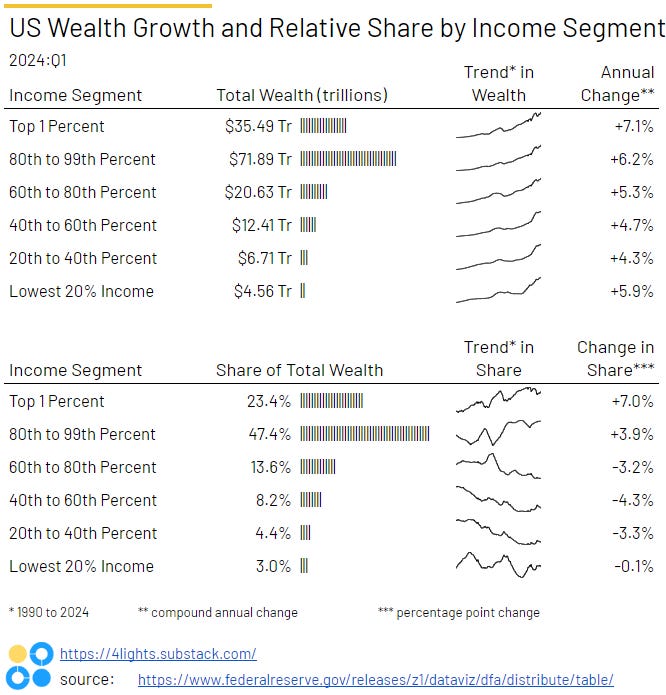
Broadly speaking, the middle income segments have increased their net wealth by about +5% per year since 1990; however that same income group’s share of total wealth has declined by nearly 11% percentage points during that time. In other words, in 1990 the middle income segments’ net wealth was about 37% of total US wealth. Now, the same middle income segments’ net wealth has declined to 26% of total US wealth.
The lowest 20% income earners have seen their net wealth increase a bit faster than the middle, but their overall share of net wealth is unchanged since 1990. The top 20% of income earners have seen the fastest growth in wealth and have increased their overall share of total total wealth from 60% to 71% (and most of that gain has gone to the top 1% of income earners).
The “falling behind” narrative is often coded in weird ways, but the data shows that these trends are real. Incomes are growing faster now at the lower end of the income spectrum, but people need to feel like they are advancing.