

In early March, the U.S. Bureau of Labor Statistics reported that 157.20 million people were employed in February, 2026. One year earlier, BLS reported 157.15M people were employed for a year-on-year change of just +0.03%. That number edged up to +0.1% as March data came in with stronger jobs numbers, but year-on-year employment growth has been below +1.0% for 18 months in a row.
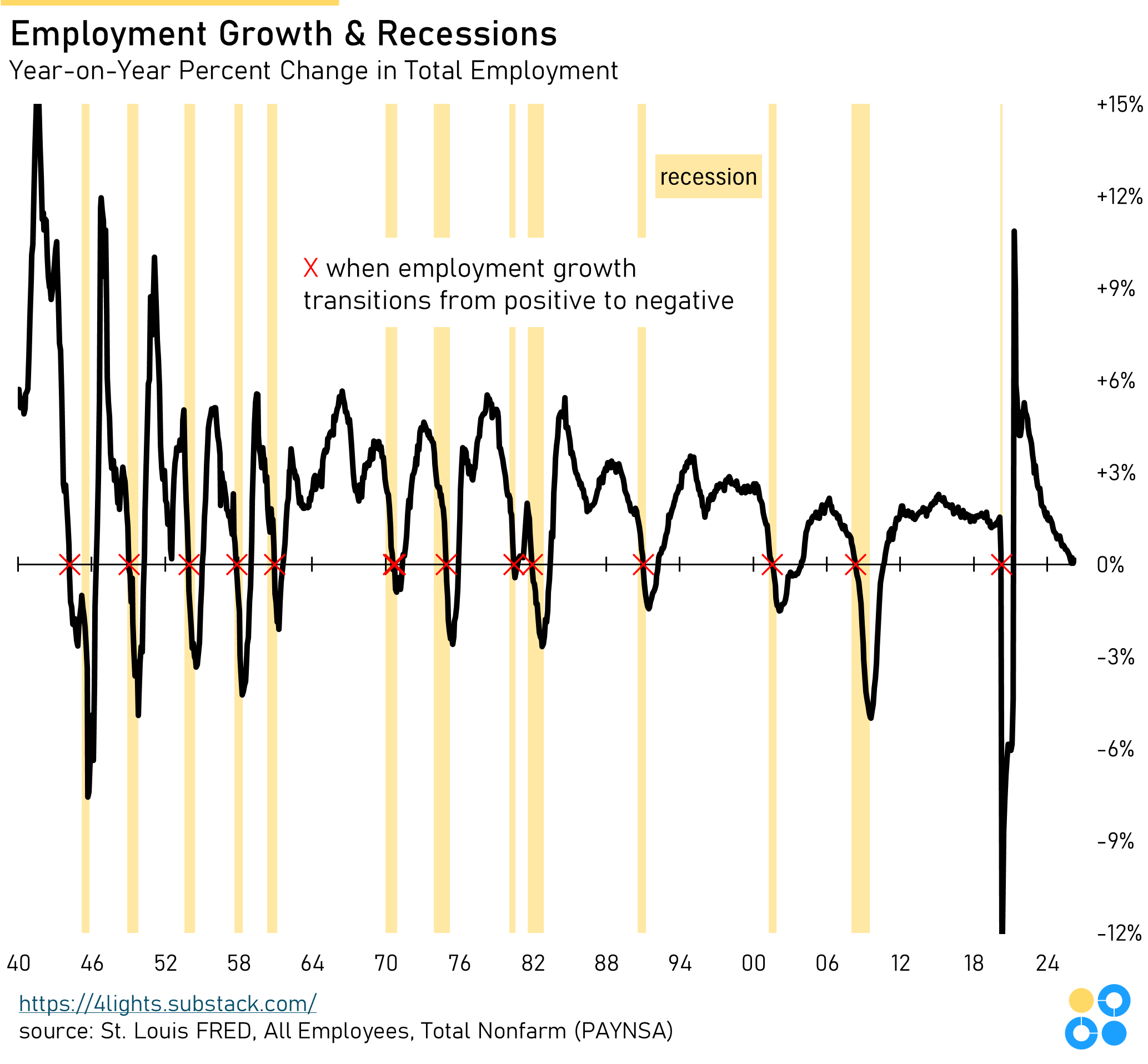
In almost every instance since the 1940s, +0% year/year employment growth meant a recession had already started.
More specifically, zooming in on the dates when year-on-year employment growth changes from positive to negative, it almost always means a recession started a few months prior.
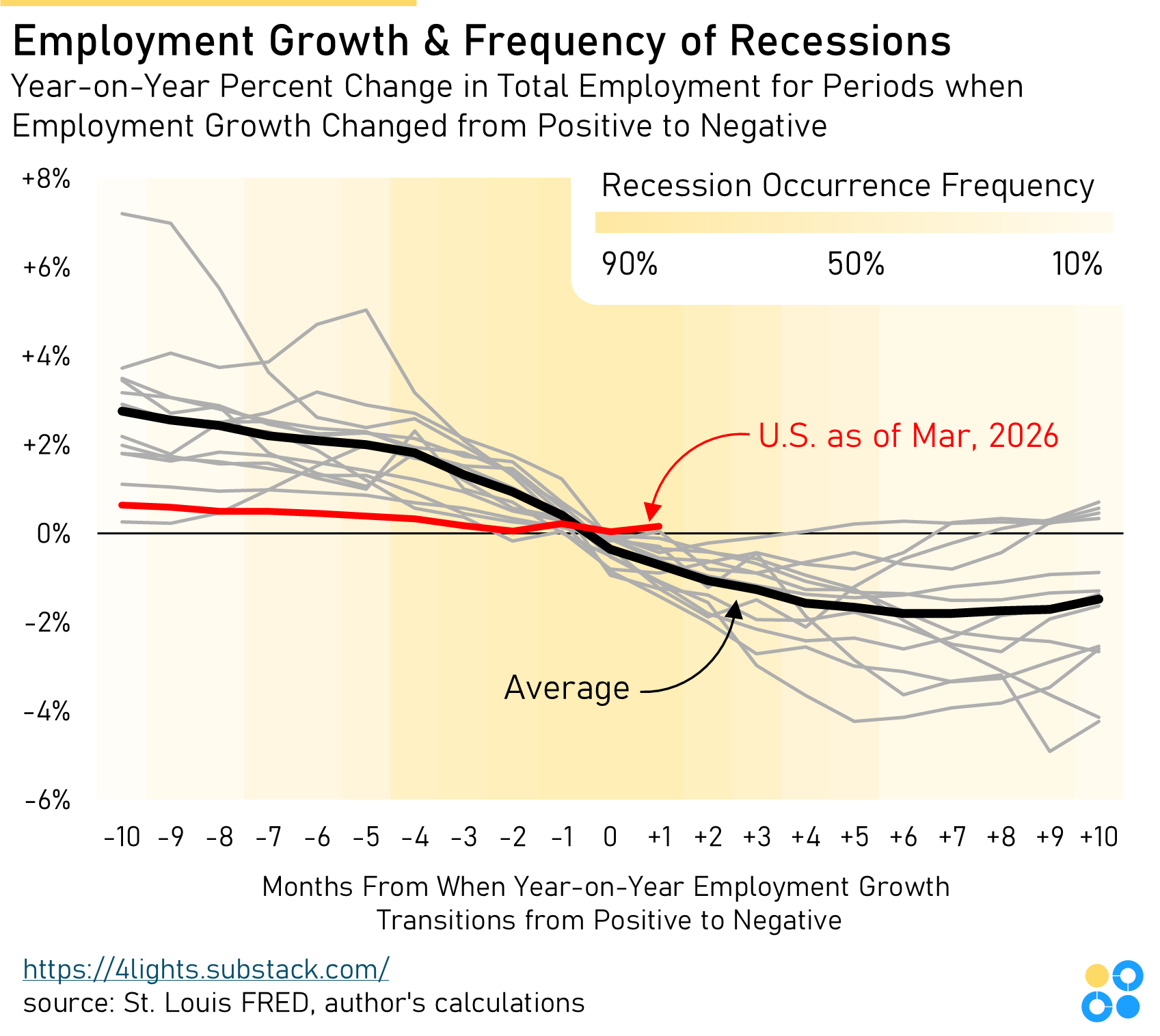
Does that mean the U.S. is in a recession? Not technically. Despite this tepid employment growth, GDP growth came in at +2.0% for Q1, 2026. Not terrible! However, that growth was heavily dependent on nonresidential investment (i.e. business investment). Private consumption on goods and residential investment both declined, which tells us that businesses are keeping the economy out of recession, not consumers with higher paying new jobs.
In other words, we may have already entered a world where the employment growth ⇄ recession relationship no longer holds. If business investment — driven by the AI buildout and automation boom — becomes the dominant source of GDP growth, strong output and weak job growth could coexist indefinitely. The old recession indicators were built for a labor-driven economy. This one may not be.